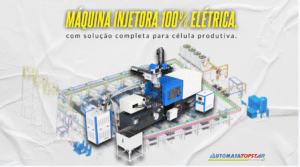
During Interplast, Automata highlights its complete solution for production cells, developed to increase the performance, efficiency, and operational intelligence of the factory floor. The solution was designed to meet the real demands of plastic processors, combining automation, precision, and connectivity. The goal is to reduce setup times, optimize production cycles, and ensure high repeatability, allowing industries to reach new levels of competitiveness, predictability, and process control.
The fair’s audience will be able to see firsthand the approach that integrates hardware and software into a single system capable of synchronizing all stages of production. The proposal is to offer a ready-to-operate production unit, where each component of the production cell works in a coordinated manner, ensuring continuous flow, operational stability, and data-driven decision-making.
By adopting this systemic vision, Automata contributes to the advancement of plastics industries towards more efficient and intelligent production models. The “turn-key” production cell delivered by the company integrates everything from raw material feeding and dosing to the main processing, whether by injection or extrusion, in addition to output automation with robotics and peripherals. This concept eliminates bottlenecks, reduces waste, and increases process reliability.
Another strategic aspect of the solution is production standardization. By automating and integrating the process steps, the production cell ensures technical consistency and constant quality, ensuring that each piece produced maintains the same standard, regardless of volume or operating time. This predictability is fundamental for industries seeking to meet increasingly demanding and regulated markets.
AUTOMATA’S PRODUCTION CELL FOLLOWS THE INDUSTRY 4.0 CONCEPT
The proposal of Automata’s production cell directly aligns with the principles of Industry 4.0. Real-time data collection, connectivity between equipment, and the possibility of remotely monitoring performance indicators, such as OEE and energy consumption, allow managers to have a broad and strategic view of production. This level of control facilitates the implementation of preventive maintenance, the identification of improvement opportunities, and the reduction of operating costs.
In the current context, where energy efficiency and sustainability are decisive factors, Automata’s solution also stands out for optimizing energy consumption. The system coordinates the operation of peripherals according to the cycle of the main machine, avoiding waste and contributing to more sustainable operations. This differential directly impacts the competitiveness of companies, by reducing costs and strengthening practices aligned with environmental requirements.
The company presents a strategic vision of production, in which technology, automation, and process intelligence connect to generate real value for the business. By replacing fragmented models with integrated systems, Automata shows how it is possible to transform the factory floor into a more agile, predictable environment prepared for the challenges of the future.
INTEGRATED SYSTEM AND NATIVE COMMUNICATION
The concept of production cells developed by Automata represents a significant evolution compared to traditional production models. Instead of operating isolated machines, industries now have an integrated system where all equipment and peripherals communicate natively. This integration eliminates communication failures between devices from different brands, reduces operational risks, and increases the overall efficiency of the process.
The solution’s unified interface allows for quick parameter adjustments and agile mold changes, drastically reducing setup time. This factor is crucial for companies that work with a wide variety of products and need to respond quickly to market demands. By minimizing machine downtime, the production cell contributes to increased productivity and improved utilization of available resources.
Another relevant differentiator is the solution’s ability to adapt to the specific needs of each client. Production cells can be configured according to the type of process, production volume, and characteristics of the final product. This flexibility allows Automata to serve operations ranging from medium-sized to more complex projects, always focusing on performance, reliability, and scalability.
ABOUT AUTOMATA
Automata do Brasil specializes in industrial automation and robotics for the plastics sector. Focusing on modernizing manufacturing facilities and increasing the productivity of processors, the company develops technological solutions that integrate machines, peripherals, and control systems in intelligent production environments.
Its core business lies in the development of integrated systems that transform isolated equipment into high-performance production cells. By combining engineering, software, and automation, Automata delivers complete projects that raise the level of efficiency, precision, and competitiveness of the industries it serves.